
THE DEVELOPMENT STORY

It took a lot of Alphas to make the workflow look simple.

Frontier AI changed what a small tax practice could attempt. The work still required tax research, architecture, implementation, independent challenge, regression tests and human judgment.

Alpha 14 — human testing and broader operating-business coverageFollow the Alpha history
S-Corp Engine / actual workspaceSynthetic example
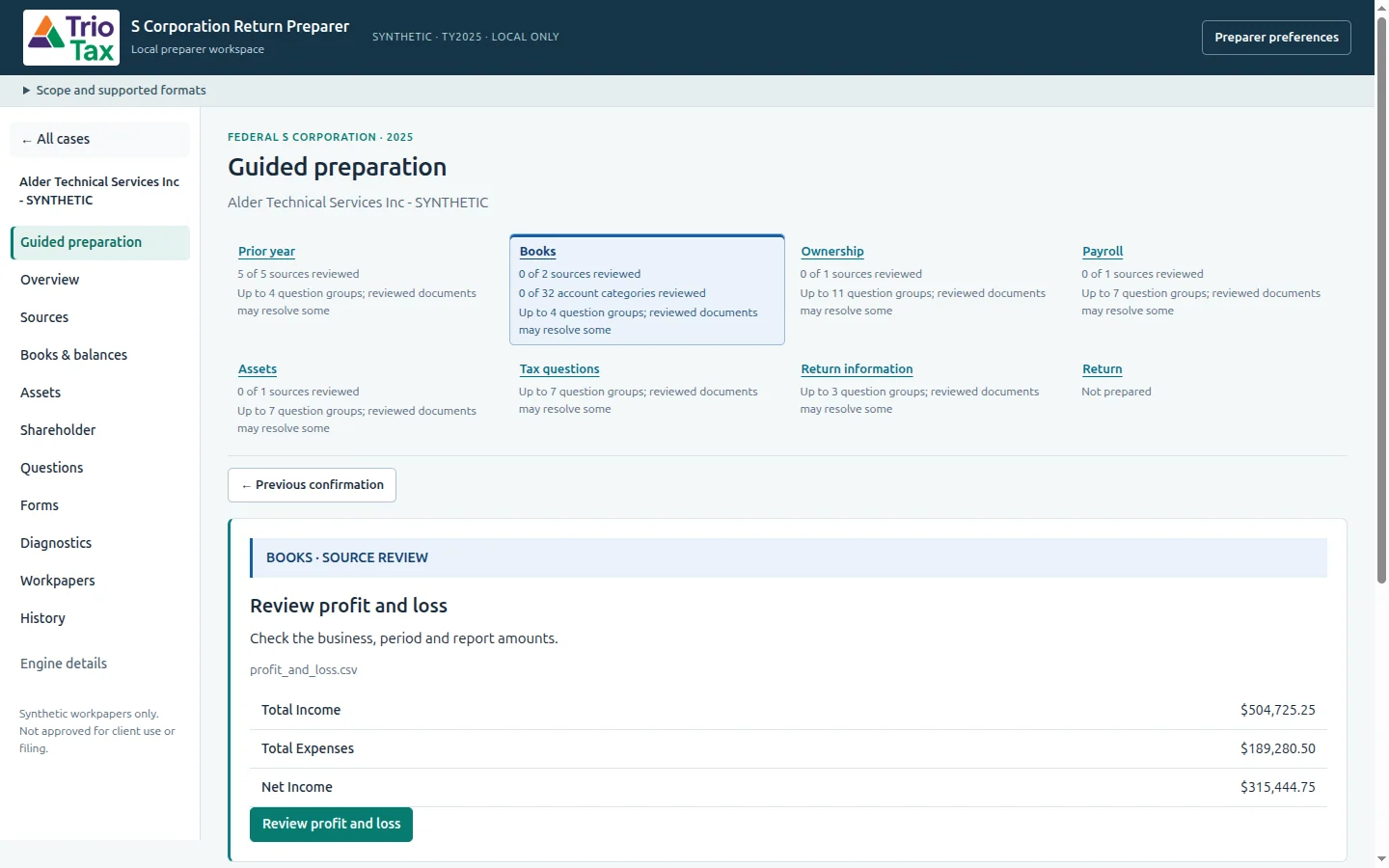
The current polished Guided Preparation interface with professional task hierarchy and direct navigation to return work.
The current Guided Preparation workspace. The simple surface is the result of many engineering generations. Synthetic example.Synthetic example · Click to inspect

A TAX PRACTICE, BUILDING ITS OWN TOOLS

The difficult parts are the product.

PrepReturns began with the practical problems of a working tax firm. The traditional choices were familiar: work around a limitation, send a feature request, change vendors or build another spreadsheet.

AI-assisted development opened another path: build the software we wanted to use. That possibility became a serious S-corporation preparation project through successive Alphas, each answering a new question while protecting the work already done.

More tax scope meant more than additional formulas. It meant inconsistent sources, unknown opening balances, owner-specific histories, stale calculations and forms a human could actually inspect. Every new feature created new obligations elsewhere in the return.

Where the project began

THE DEVELOPMENT LOOP

Models had roles.
Humans kept authority.

Research, implementation and review are different jobs. Coordinated workers handled bounded, separate tasks. Fresh reviewers challenged results from a new context. The lead owned shared architecture, integration and repairs.

The tax practice defined the problem and acceptance standard. A model could propose, implement and critique; it did not acquire authority over the tax return by writing the code.

  1. 01

    Tax practice

    Define the problem, scope, workflow and acceptance standard.

  2. 02

    Model and agent team

    Research, propose architecture and implement bounded work.

  3. 03

    Automated tests

    Challenge calculations, dependencies, history and artifacts.

  4. 04

    Fresh model review

    Re-derive expectations and question the implementation.

  5. 05

    Browser and PDF inspection

    Exercise the workflow and inspect what people actually see.

  6. 06

    Human professional review

    Accept, reject, refine—and define the next Alpha.

MODELS DOCUMENTED IN THE ALPHA RECORD

Early Alpha records name GPT-6 Astra / High as the requested worker configuration for implementation, research and fresh review, with an owner-requested Astra Extra High lead setting. The records document coordinated agent work but do not expose independent runtime model telemetry. These are documented settings, not a claim that every later task ran on a verified model configuration.

Independent model review is a fresh engineering challenge, not external professional certification.

A CUMULATIVE ENGINEERING HISTORY

Each Alpha asked
a harder question.

A version number marks a change in what the system can explain, preserve and produce.

01

Foundations · Alphas 1–3

First, make the tax logic stand on its own.

Can every result be reproduced and independently challenged?

The first generations built explicit money handling, ordinary and separately stated items, depreciation, basis, and cross-form reconciliation. Book equity, retained earnings, AAA, stock basis and debt basis had to remain different concepts even when their numbers looked similar.

What it addedA deterministic federal S-corporation core, independent synthetic calculations, and explicit unavailable results when required facts were missing.

What it now had to protectProtect cents, rounding, ordering and tax character before adding a professional interface.
02

Source-driven preparation · Alphas 4–6

A calculator is not a preparation workflow.

Can a return begin with what the preparer actually receives?

Financial statements, prior returns, spreadsheets and source schedules introduced another layer of interpretation. An imported label still needed a classification. A prior-year number still needed the right period. A successful parse was only the beginning of preparation.

What it addedStructured intake, financial-statement import, bounded source parsing, account mapping, source review and source-to-return examples.

What it now had to protectTest the route from original evidence to facts, separately from testing tax arithmetic.

03

Professional workspace · Alphas 7–8

Then make it a place to work.

Can the system preserve the case as carefully as the calculation?

A local browser workspace brought case storage, source preservation, backup and restore, migration behavior, and history verification into the product. Financial workpapers and explanations made the state of the case easier to inspect.

What it addedA recoverable local workspace, direct review tools and stronger presentation. The retained Alpha 9 handoff records 659 passing tests when verifying its Alpha 8 baseline.

What it now had to protectA saved case must retain evidence and history, survive recovery, and explain what changed.

04

Preparer experience · Alphas 9–10

Ask the next useful question.

Why should a preparer have to think like the software?

Guided Preparation organized work around the return: business and prior year, books, owners, payroll, assets, unresolved facts and review. Direct workpapers stayed available. The guide became another view of the same preparation, rather than a parallel set of answers.

What it addedContextual preparation, saved interview state, first-use improvements and direct forms/workpaper access.

What it now had to protectPreserve drafts, context and professional choices while moving between guided and direct work.

05

Evidence and authority · Alphas 11–11.4

Reading a number does not establish its authority.

What happens when the source is wrong—or the parser is?

This generation separated original evidence, proposed readings and preparer-established facts. Corrections, missing-item repair, exclusions and replacement had to preserve history. Later audits made the remaining source-dependence and reconciliation problems explicit instead of hiding them behind a successful import.

What it addedSource correction and review history, clearer manual/source authority, and explicit current-year versus opening-state contracts.

What it now had to protectA correction must not silently overwrite the document or a later preparer decision.

“If a source says $72,000 and the preparer establishes $68,000, the system should not pretend the source said $68,000.”
06

Official forms · Alphas 12–12.1

The workflow ends with the actual return.

Which preparation produced the form in front of you?

Official IRS Forms Mode connected saved calculations to actual PDF output, supporting statements and workpapers. A manifest organized the package. Line explanations and optional diagnostics referred to that same saved return.

What it addedOfficial forms, selective Print / Save PDF, How calculated, saved-package diagnostics and current-versus-historical output.

What it now had to protectChanged facts must make current output stale without changing the historical package.

07

Broader S-corp scope · Alpha 13

Make room for the owners behind the business.

Can one corporate return preserve different owner histories?

Multiple shareholders brought allocation, rounding, direct loans, basis restoration, suspended losses and owner-specific reporting together. Asset sales, initial S years, officers and supported retirement workflows widened the preparation path.

What it addedExpanded Form 7203, debt and carryforward history, Form 4797, retirement support and the Alder synthetic company.

What it now had to protectCorporate allocations must remain intact while each owner’s basis and private package remain separate.

08

Richer operating businesses · Alpha 14

Conventional can still be complicated.

Can broader business scope survive the whole preparation path?

Rental real estate, inventory, corporate capital sales, vehicles, amortization, paid shareholder-loan interest and accountable-plan reimbursements entered the same engine. Cedarline brought these areas together in a richer synthetic company.

What it addedFour new official form families, expanded 4562/4797 output, broader workpapers and human testing.

What it now had to protectKeep separate tax characters, prevent duplicate book entries, inspect visible PDFs and recheck older returns.

Explore the current capability boundaries

SYNTHETIC BUSINESSES AS A TEST LADDER

Juniper.
Alder.
Cedarline.

01 / THE CORE PATH

Juniper

A simple S corporation for the source-to-return preparation path, forms and workpapers. The ordinary workflow remains a regression reference as the engine expands.

02 / DIFFERENT OWNER HISTORIES

Alder Technical Services

Two owners at 70/30, suspended ordinary losses, debt restoration, different officer payroll, SEP contributions and an equipment sale. The same corporate result must respect each owner’s facts.

03 / A RICHER OPERATING BUSINESS

Cedarline Equipment & Supply

Two owners at 60/40, inventory, commercial rental, brokerage lots, a company car, amortization, interest and reimbursements. Related calculations now cross more forms and workpapers.

Alpha 14 / development captureSynthetic example
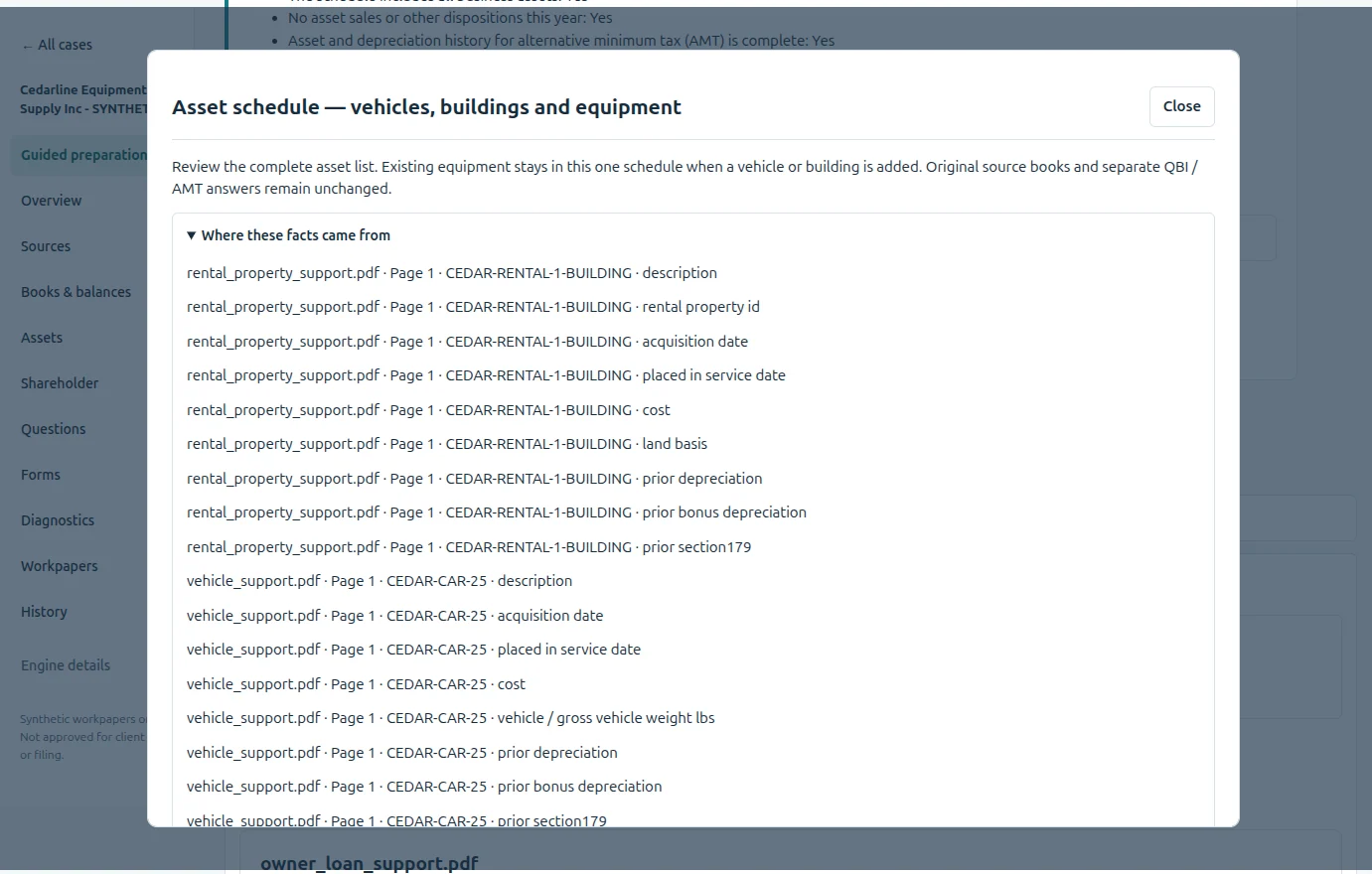
Historical Alpha 14 Cedarline asset editor listing source references for rental property and vehicle purchase and recovery facts.
Cedarline vehicle preparation during Alpha 14 engineering work. Historical interface; synthetic example. Vehicle facts and elections require their own review.Synthetic example · Click to inspect

TAX RESEARCH HAD TO REACH THE PRODUCT

A research note is not an implementation.

The Alpha 14 research work connected primary tax authority with precise input requirements, reporting destinations and exclusions. A rental feature needed property facts, depreciation context, separate rental character and actual Form 8825. Inventory needed an established method and reviewed eligibility before cost components could become tax COGS.

Capital transactions required preserving short- and long-term character and distinguishing supplied broker adjustments from independent wash-sale detection. Vehicles introduced acquisition dates, service vintages, business-use evidence and limits. Amortization needed cost categories and prior recovery, not a generic “intangible” checkbox.

Each decision crossed layers: source proposals, direct editors, Guided Preparation, calculation, owner reporting, saved history and official output. Tests had to challenge that whole route.

TWO PROBLEMS THE CODE ALONE DIDN’T EXPLAIN

Correctness has to survive contact with the output.

ENGINEERING STORY / 01

The fields were mapped.
The forms looked blank.

During Alpha 14, direct PDF inspection found blank visible text in four new official form families even though the mapping ledgers contained the right values.

Page selection through the PDF library had lost appearance data from in-memory form objects. A test that checked only the mapping could pass while the preparer saw an empty form.

The renderer was changed to serialize the flattened PDF before selecting the applicable pages. The team then checked actual PDF content, identity, amounts and rendered appearance.

A field existing in the data is not the same as a number appearing on the page.

ENGINEERING STORY / 02

Preserving history
became expensive.

The richer Cedarline case grew to 106 revisions. Rechecking whole history for every selected export created long waits; one combined export exceeded the browser driver’s download timeout.

The repair reused verified subtrees only with exact dependency proofs. Export still checked selected-file membership, safe paths and hashes. The old history stayed intact, and tamper protection stayed in place.

A restarted-server measurement of the same case fell from about 59.9 to 14.4 seconds for cold opening on the test VM. That was a bounded engineering improvement, not a current universal performance benchmark.

Integrity is a feature with real implementation costs.

ALPHA 14 / SCOPED ENGINEERING EVIDENCE

Evidence with
its context intact.

The original Alpha 14 handoff recorded the following results for the Cedarline synthetic case and its downloaded package. They describe that milestone and fixture, not all possible S-corporation returns or later changes.

The richer case also exercised a stale-output transition: an address edit invalidated current Forms and Diagnostics, Update Return created a new package, and the earlier preparation remained accessible as history.

271 / 271
Independent numeric and reporting comparisons for Cedarline’s downloaded prepared result.
98 / 98
Package and actual-PDF content checks, including selected pages and owner-specific contents.
46 / 94
Documents / combined pages in that richer synthetic package. Package size varies with the case.

The full-suite result was mixed—and recorded that way.

The full Alpha 14 repository run reported 1,771 passed, 2 failed, 3 skipped, and 2,164 subtests passed. The two failures were obsolete harness assumptions; affected reruns resolved them. The original result remained in the record rather than being described as an all-green full run. Tests and subtests are separate counts.

These are engineering checks. They do not establish filing readiness, commercial-software parity, professional certification or completed owner human acceptance.

QUALITY COMES IN LAYERS

There is no single
“tax accuracy” test.

One large number cannot tell you whether the right thing was tested. The useful story is how the layers challenge different failure modes.

  1. 1

    Pure calculations

    Literal expected values, cents, rounding, ordering and boundary cases.

  2. 2

    Integrated return

    Relationships across ordinary income, K/K-1, L/M-1/M-2, assets and owner basis.

  3. 3

    Source workflow

    Parsing, mapping, corrections, replacement, provenance and supported manual input.

  4. 4

    Saved state

    Historical and current packages, stale output, backup/restore and tamper checks.

  5. 5

    Browser behavior

    Actual visible preparation actions in fresh synthetic cases.

  6. 6

    PDF and package output

    Text, appearance, page selection, saved-document integrity and owner-specific contents.

  7. 7

    Human acceptance

    The tax professional’s assessment of the workflow, judgment and product.

AFTER THE BROADER ENGINE

Make the professional workflow feel coherent.

A dedicated UI pass refined navigation, typography, task hierarchy, tables, long editors, Forms framing, diagnostics and focus behavior while preserving tax logic and evidence.

Its visible browser review covered the major preparation destinations, source correction, owner and asset editors, forms, line inspection, diagnostics, Print / Save and fresh examples at desktop sizes from 1366×768 through 1920×1080.

A later source-provenance correction also removed an advanced-example preload shortcut. Supported source bytes now produce reviewable proposals through the ordinary parser path. Acceptance supplies facts to ordinary editors; it does not select professional treatments or prepare the return.

That correction matters to the product’s central claim. A realistic example should demonstrate the evidence workflow, not quietly skip the hardest part of it.

How source authority works now
S-Corp Engine / actual workspaceSynthetic example
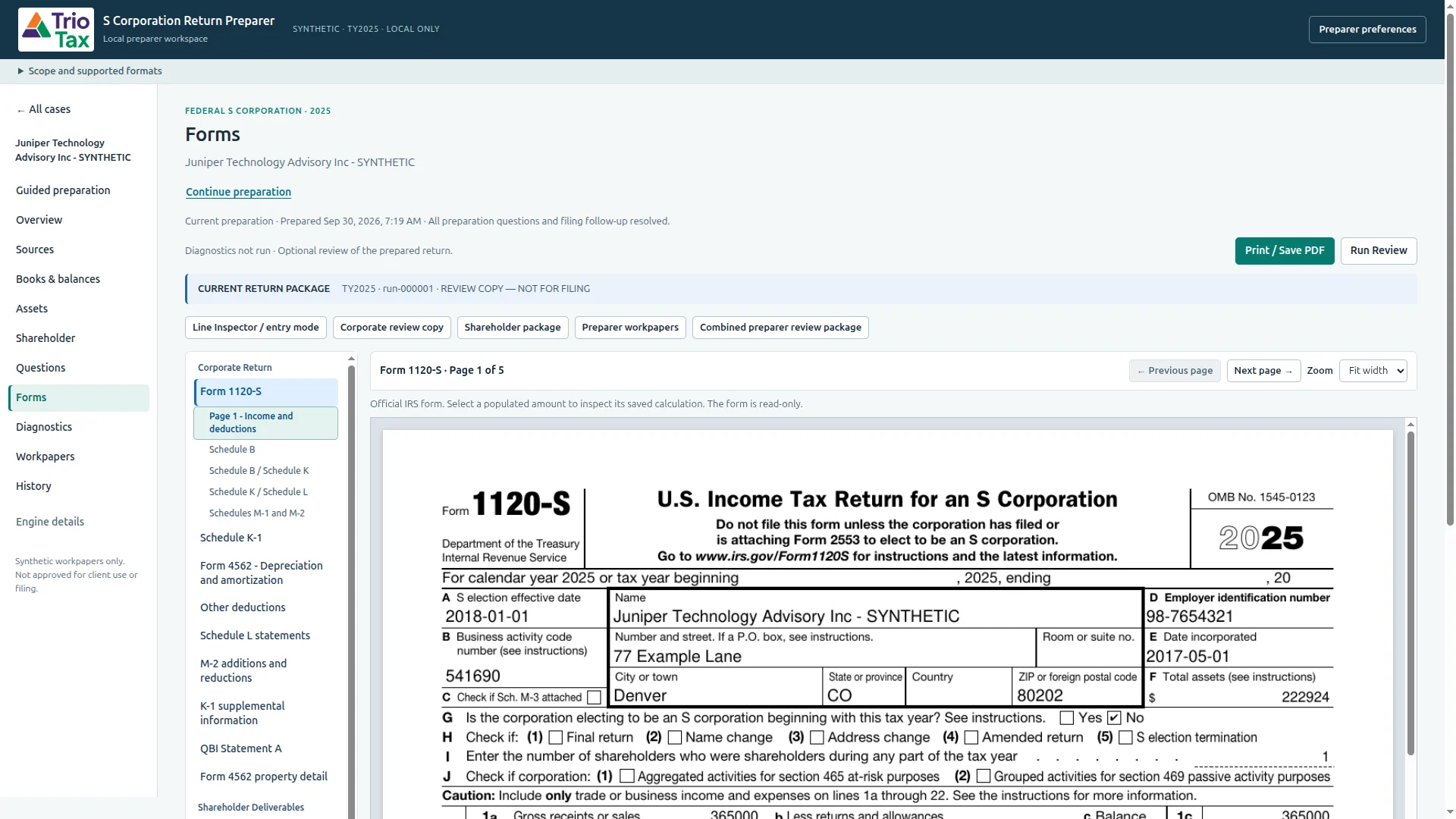
Current polished Forms Mode displaying a synthetic Form 1120-S beside its return package and review tools.
Current polished Forms Mode. Browser and output inspection complement code tests; they answer different questions. Synthetic review copy.Synthetic example · Click to inspect

HUMAN AUTHORITY

The final model is not the final reviewer.

Frontier models can research, implement, critique and test. They can find defects another model introduced. They can exercise a browser and compare output.

They do not own the tax practice. The human professional has to use the system, understand its boundaries, explain the work and decide what is acceptable.

Alpha 14 is the human-testing generation. Engineering qualification and agent-operated browser review are valuable evidence. They are not a declaration that human acceptance has been completed.

The next improvement may be a missing tax capability. It may also be a clearer question, a better source conflict or a form that is easier to review. The professional workflow is part of the product’s correctness.

THE NEXT GENERATION

Next: the
individual return.

Explore the 1040 direction

The S-corp work established reusable principles: provenance, explicit unknowns, deterministic calculations, saved history, direct forms and professional review.

It also exposed assumptions that belong to the corporate domain. A household, its people and dependents, wage and investment sources, credits and individual limitations deserve their own model.

The long-term business-to-owner connection should pass structured shareholder information across a defined boundary. It should not force the two engines into a circular dependency.

Share the principles. Let the domains be different.

WHAT CHANGED

The interesting part is what a tax practice can now attempt.

Research, implementation, testing, review and iteration can now be coordinated at a scale that makes an end-to-end preparation system a plausible project for a small practice.

That is a change in the economics of professional software. PrepReturns is still becoming what we want it to be. The work so far makes the next questions much more interesting.

What can a small tax firm build now?

Let’s compare notes.

Tax professionals, engineers, researchers and software companies: there is plenty here to challenge, discuss and build on.

Talk about the project

Open full-size image ↗