
THE PREPARATION PATH

From evidence to return.

The goal is to connect the whole preparation—not simply add another input screen. Each stage keeps the source, the decision and the result in a relationship the preparer can inspect.

  1. Source documentsEvidence comes first
  2. Reviewed factsPreparers establish authority
  3. Deterministic tax logicRepeatable calculations
  4. Forms & workpapersA return you can explain
01

Ingest

Bring the evidence into the preparation.

Begin with supported prior-return PDFs, financial exports, payroll information, asset schedules and supporting records. The original material is retained. A source has an identity, a period and a place in the case; it is more than a file attached at the end.

Original evidence stays original.
02

Understand

Turn supported source readings into proposals.

Bounded parsers extract structured facts from supported layouts. Carried-forward information remains distinguishable from current-year evidence. The software can propose an amount, an owner record or a loan history without treating the proposal as a professional conclusion.

A successful extraction is not acceptance.
03

Verify

Review what is right. Resolve what is not.

The preparer accepts source readings, corrects misread values, excludes duplicates and reviews classifications. Source locations and correction history remain available. Additional facts belong in the appropriate direct workpapers, without pretending that an absent fact came from a document.

Automation proposes. Preparers decide.
04

Prepare

Ask the questions that remain.

Guided Preparation uses the state of the case to direct attention to missing facts, current-year confirmations, elections and tax treatment. Source acceptance does not make those decisions. Direct books, assets, shareholder and other supported editors remain available alongside the guide.

Professional judgment is an input, not an inconvenience.
05

Calculate and review

Make the result reproducible.

Established facts flow through deterministic tax rules. Workpapers explain calculations and reconcile related values. Forms and How calculated provide direct inspection; optional diagnostics review the saved prepared result. A missing prerequisite withholds the dependent conclusion rather than fabricating certainty.

One preparation. Connected explanations.
06

Produce

Create the forms and the package.

Applicable official forms, statements, shareholder deliverables and internal workpapers are organized in a saved package. Selective Print / Save PDF uses that package. A later change makes current output stale; Update Return creates a new preparation while preserving the earlier result as history.

The finished package retains its history.

THE HUMAN IN THE WORKFLOW

Review the fact.
Make the decision.

A payroll schedule can report compensation. It cannot settle every question about tax treatment. A mileage record can report business use. It does not independently choose an election.

That separation is intentional. Supported source processing reduces transcription, while the preparation workflow makes the remaining professional work visible.

Understand source authority
S-Corp Engine / actual workspaceSynthetic example
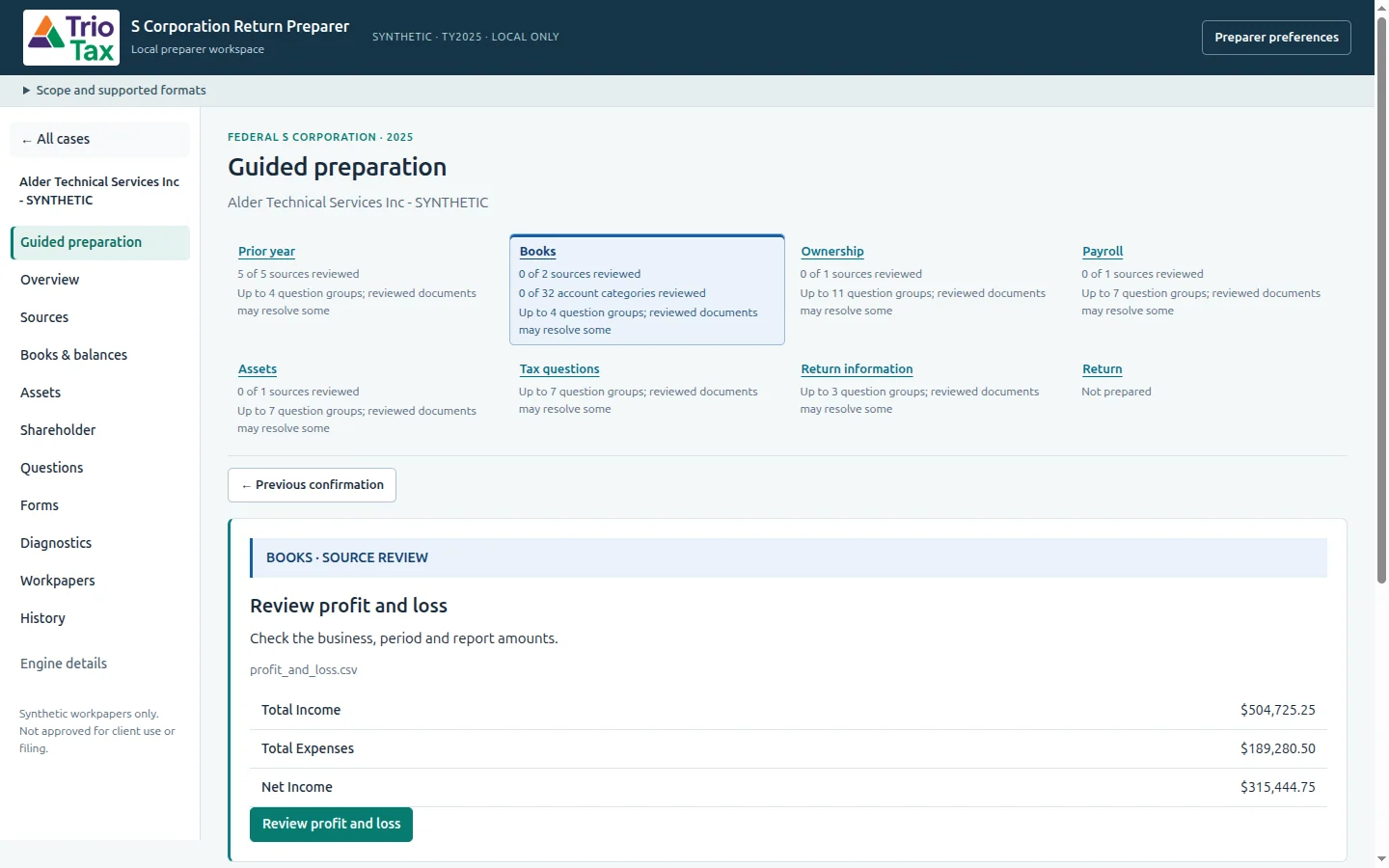
Guided Preparation displaying contextual tax-preparation tasks and source-review actions.
Guided Preparation connects established evidence with unresolved facts and decisions. Synthetic example.Synthetic example · Click to inspect

A PRACTICAL BOUNDARY

A clear path needs a clear scope.

The current S-Corp Engine uses deterministic parsers for supported source layouts. Generalized document ingestion is a direction, not a claim that any scan, spreadsheet or PDF can be understood today.

The resulting “finished return” is a prepared package. Filing, transmission, signatures and the owner’s complete individual return are distinct work.

Explore the current capabilities

See the whole path in the product.

Source review, Guided Preparation, tax decisions and actual IRS forms in the current S-Corp Engine.

Explore the S-Corp Engine

Open full-size image ↗