
EVIDENCE AND PROVENANCE
A number should have a history.
Tax preparation starts with evidence. The useful question is not only “What is the amount?” It is “Where did it come from, what did we decide, and which return used it?”
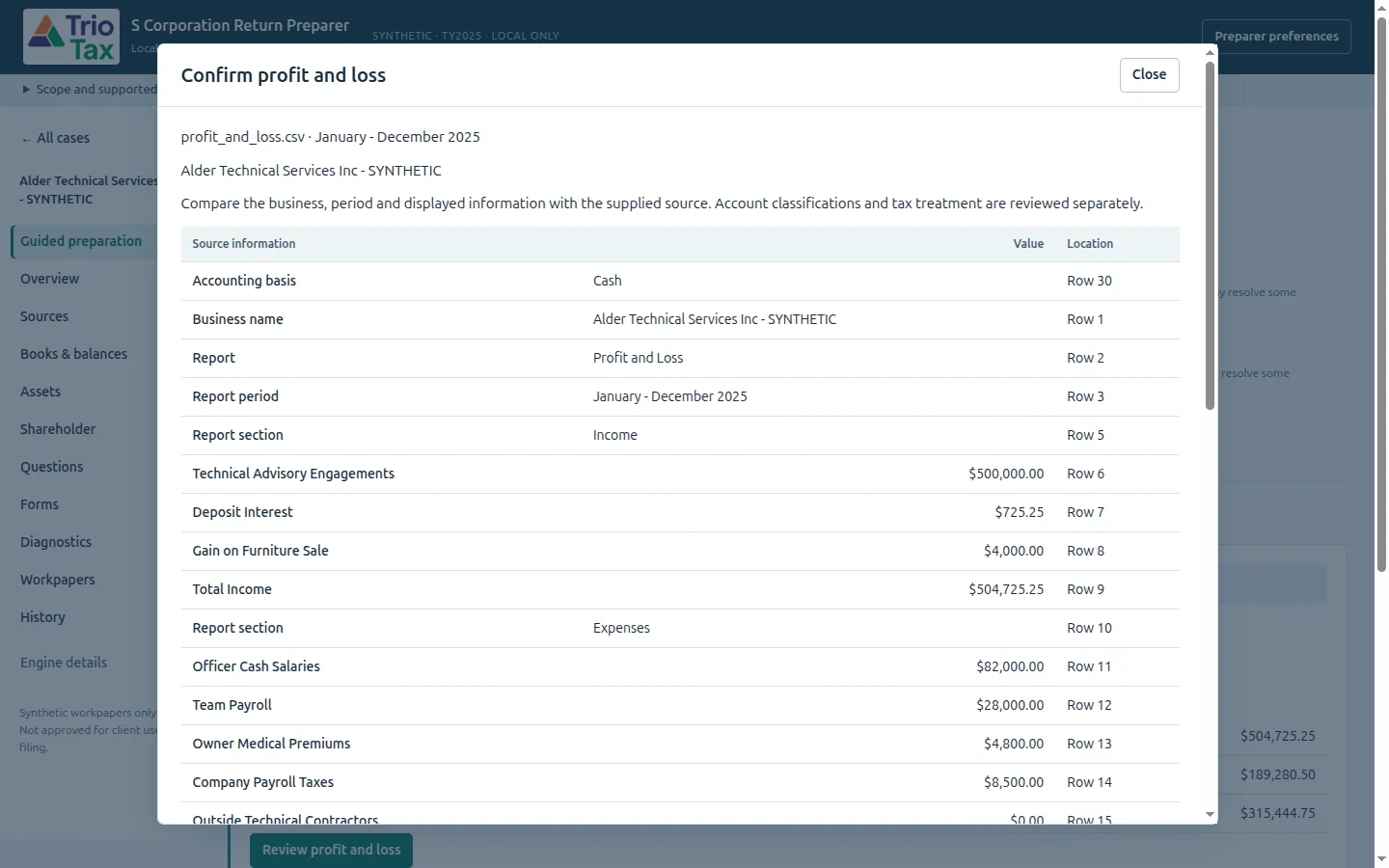
The source stays original.
If a document says $72,000 and the preparer establishes $68,000, the system should not pretend the document said $68,000.
The original evidence, the software’s reading, the preparer’s correction and the effective fact describe different things. Preserving those distinctions gives the next reviewer a way to understand the result.
A CHAIN OF AUTHORITY
From what was reported
to what was established.
- 01
Original source
Retained document bytes, identity and period.
- 02
Proposed reading
Extracted value with a source location.
- 03
Preparer review
Accept, correct, exclude or resolve.
- 04
Established facts
Reviewed inputs and explicit tax decisions.
- 05
Saved result
Calculation, workpaper and form output.
This is a preparation relationship, not an assertion that every source format or every reconciliation problem is already automated.
CORRECTIONS WITHOUT AMNESIA
“Read wrong” and “booked wrong” are different.
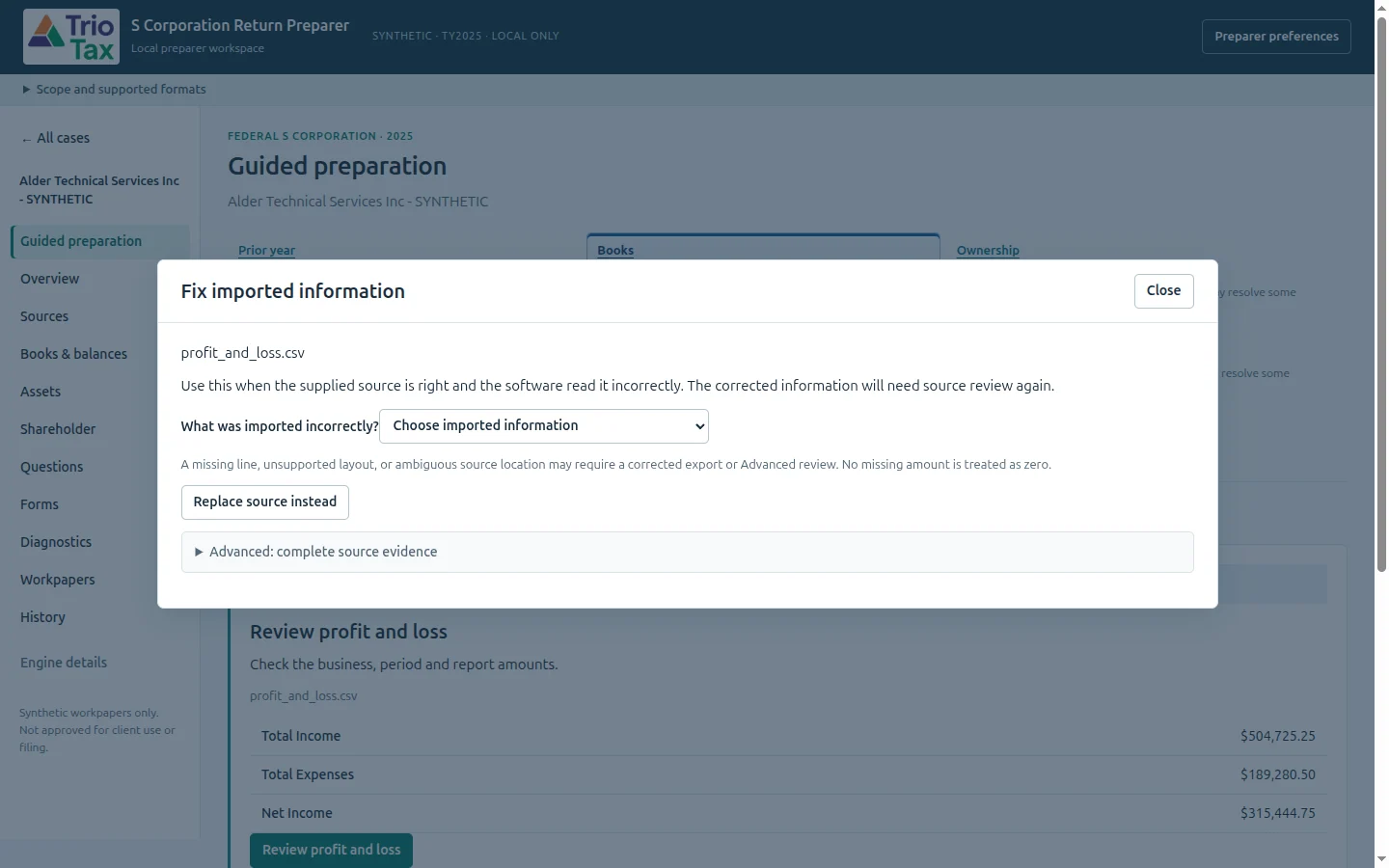
A parser correction repairs the software’s reading of the document. A book error requires a documented accounting or tax resolution. Treating both as a source overwrite would erase the distinction the reviewer needs.
Supported corrections retain the original source, earlier reading, revised reading, reason and review history. Affected facts must be reviewed again. Later conflicting preparer edits are protected from automatic replacement.
That protection can also expose an unresolved conflict. The source-independence work has identified complex replacements, opening-balance bridges and account splits that need a fuller resolution workflow.
MEANING BEFORE CONVENIENCE
Unknown is not zero.
A blank opening basis is not proof of no basis. A missing loan schedule is not proof that there are no loans.
The distinction matters because a perfectly reproducible calculation can still be wrong if its inputs pretend to know more than they do.
- Known zero
- Evidence and review establish that the amount is zero.
- Unknown
- The necessary fact has not been established.
- Not applicable
- The reviewed facts establish that the question does not apply.
- Unsupported
- The situation falls outside the implemented calculation or workflow.
- Deferred
- The issue is acknowledged and still needs attention.
REVIEW DOES NOT CHOOSE THE ELECTION
Document facts.
Professional decisions.
The current source workflow separates document facts, client assertions, professional judgment and derived results. A source may supply asset cost and a service date. A preparer still reviews classification, history and elections. The engine calculates depreciation afterward.
Likewise, accepting an owner’s loan schedule can supply the stated balance and transactions without certifying that the debt qualifies or that the history is complete. The relevant editor remains subject to its own review.
Manual entries stay available for supported facts absent from a source. They must be represented as manual work, not assigned an invented document citation.
Read the full argumentHISTORY THAT BELONGS TO THE RETURN
Yesterday’s package should stay yesterday’s package.
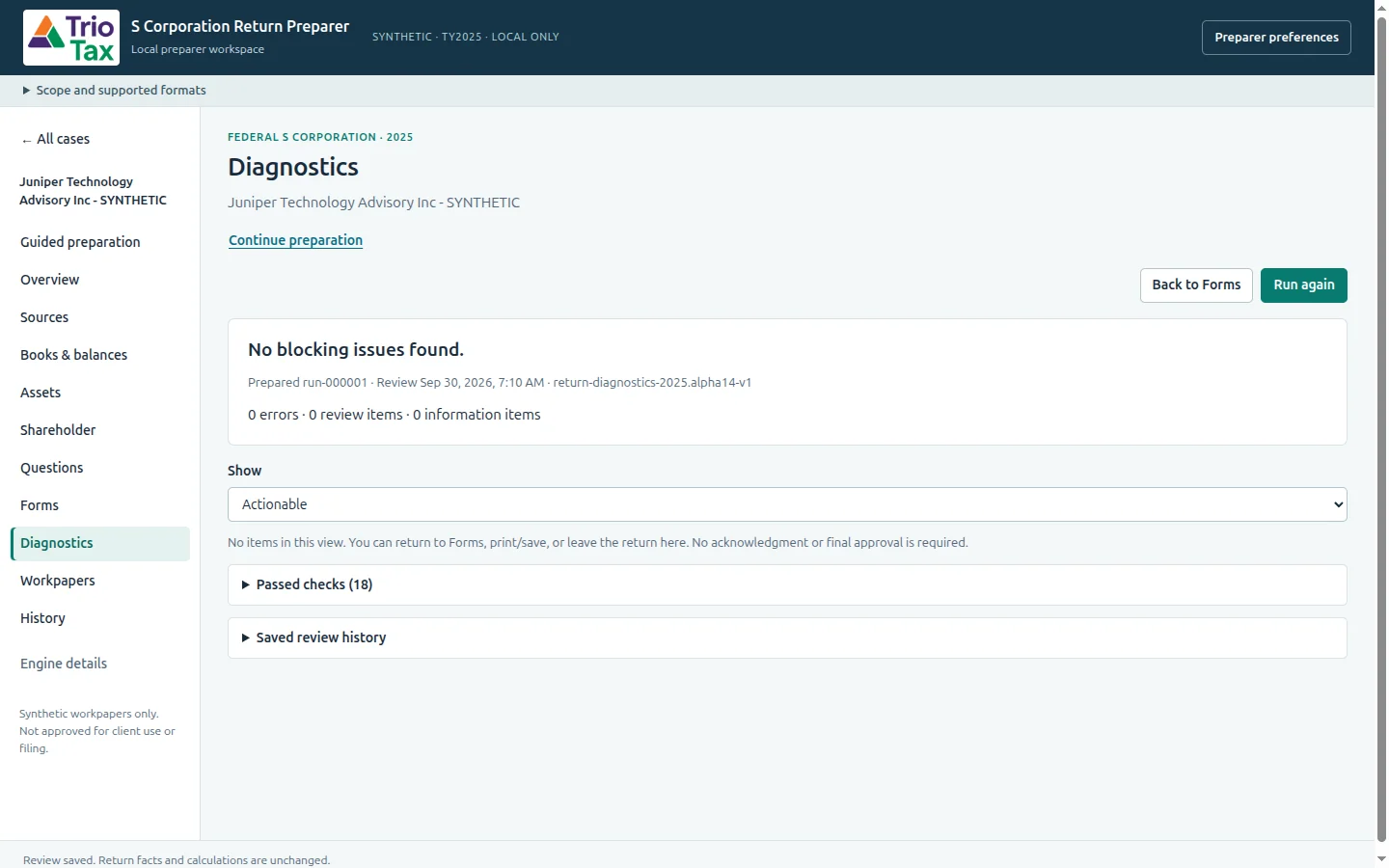
A saved return is tied to the facts and evidence that produced it. A later edit must not quietly change the meaning of the forms already reviewed.
PrepReturns distinguishes current and historical prepared output. Changing relevant inputs makes the current package stale; Update Return creates another saved preparation. Forms, diagnostics and selected output stay connected to the same result.
This turns history into something useful: an explanation of how the work developed, rather than a pile of PDFs with similar filenames.
Every number needs a story.
Provenance is the connection between source evidence, professional judgment and a return that can be explained.